
Understanding the Retort Pouch Process: From Filling to Sterilisation
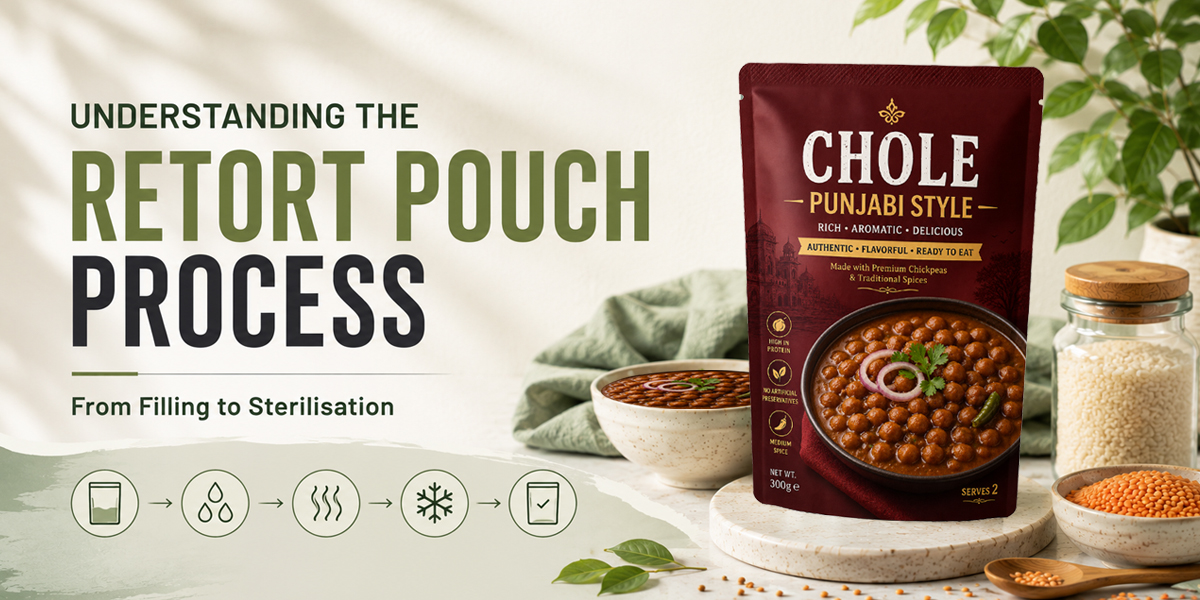
A retort pouch may look simple from the outside, but a lot happens before it reaches a supermarket shelf.
From filling the product to commercial sterilisation, every stage of the process plays a role in keeping food safe and maintaining its quality. When one step is overlooked, the effects often appear much later in the form of leaks, reduced shelf life, or product spoilage.
Understanding the process helps manufacturers make better packaging decisions from the beginning.
It starts with the product
Before packaging is even considered, manufacturers need to understand the product itself.
The consistency of the food, filling temperature, acidity, oil content, and the required shelf life all influence how the pouch should be designed. These details determine the laminate structure, seal requirements, and the processing conditions the packaging must withstand.
That’s why packaging development usually begins with the product, not the pouch.
Filling and sealing need to work together
Once the product is prepared, it’s filled into the pouch under controlled conditions.
The sealing stage is just as important as the filling stage. A strong laminate won’t compensate for a poor seal, and even a small amount of product trapped in the sealing area can affect packaging performance during sterilisation.
Maintaining clean filling conditions and consistent sealing parameters helps reduce the risk of failures later in production.
Sterilisation is where the pouch is truly tested
After sealing, the filled pouches are placed inside a retort system where they’re exposed to controlled heat and pressure.
The objective isn’t simply to heat the product. The process is carefully designed to achieve commercial sterilisation while preserving the product’s taste, texture, and nutritional quality as much as possible.
Every product has its own processing requirements, so sterilisation time and temperature are determined during product development and validation.
Related: Explore our Retort Pouches designed for reliable performance during commercial sterilisation.
Cooling is part of the process too
Once sterilisation is complete, the pouches are cooled under controlled conditions.
Cooling may seem like a simple step, but it’s important for maintaining seal integrity and overall pouch performance. Rapid or uneven cooling can place unnecessary stress on the packaging if the process isn’t properly controlled.
The retort cycle isn’t finished until both heating and cooling have been completed successfully.
Consistency matters more than speed
Manufacturers often focus on increasing production output, but consistency is what delivers reliable packaging performance.
Regular quality checks, validated processing parameters, and packaging that’s designed specifically for retort applications all contribute to a stable production process.
When these elements work together, the result is a product that reaches consumers safely and performs as intended throughout its shelf life.
Final Thoughts
A successful retort pouch isn’t created by packaging alone. It’s the result of a carefully controlled process that begins with the product and continues through filling, sealing, sterilisation, cooling, and quality testing.
By understanding how each stage affects packaging performance, food manufacturers can reduce production issues and deliver products that meet both safety requirements and customer expectations.
🔗 Suggested Internal Links
References
- Flexible Packaging Association (FPA)
- PMMI – The Association for Packaging and Processing Technologies
- ASTM International – Flexible Packaging Material Standards